
Introduction
When people search for red light street London, they’re often thinking of Soho, the West End neighborhood that became internationally associated with nightlife, adult entertainment, sex shops, and a bohemian social scene. Yet Soho’s story is far more complicated than the popular image suggests. For centuries, the area has been shaped by immigration, food, music, theatre, LGBTQ+ culture, nightlife, creative industries, and changing attitudes toward sexuality. Its reputation as London’s best-known red-light district reached its height during the 20th century, particularly from the 1950s through the 1980s. Today, Soho looks very different. Many traditional adult businesses have disappeared, while restaurants, cocktail bars, theaters, shops, offices, and cultural venues have transformed the neighborhood. Understanding that evolution gives visitors a much better perspective on one of central London’s most fascinating districts.
The History Behind London’s Red-Light Reputation
Soho’s association with the sex trade stretches back centuries. By the 18th century, the neighborhood and surrounding West End had developed a reputation for entertainment, drinking establishments, prostitution, and other forms of nightlife. Its central location made it accessible to residents, workers, travelers, and visitors looking for entertainment.
The character of Soho changed dramatically during the 19th and early 20th centuries. The area became increasingly cosmopolitan, with immigrants establishing restaurants, shops, cafés, and businesses. At the same time, entertainment venues expanded around the West End, creating an environment where nightlife and adult entertainment existed alongside everyday residential and commercial life.
The Second World War and post-war period strengthened Soho’s reputation. The London Museum describes 1950s Soho as a bohemian center filled with music venues, restaurants, coffee bars, nightclubs, and drinking establishments, alongside a strong sexual subculture.
By the 1950s and 1960s, Soho had become closely associated with adult entertainment. The introduction of the Street Offences Act 1959 affected how prostitution operated, pushing some activity away from open street solicitation and toward clubs, private premises, and other venues. Over subsequent decades, the neighborhood developed a dense concentration of sex shops, cinemas, clubs, and related businesses.
This history explains why the phrase “red-light district” became so strongly attached to Soho. It wasn’t simply about one street; it described a broader area where adult entertainment became a highly visible part of urban life.
Soho in the 1970s and 1980s: The Peak of the Red-Light District
The 1970s are often considered the high point of Soho’s adult-entertainment era. Sex shops, cinemas, strip venues, massage parlors, clubs, and so-called clip joints could be found throughout the neighborhood. Urban studies sources describe the sex industry as reaching a particularly large scale during this period.
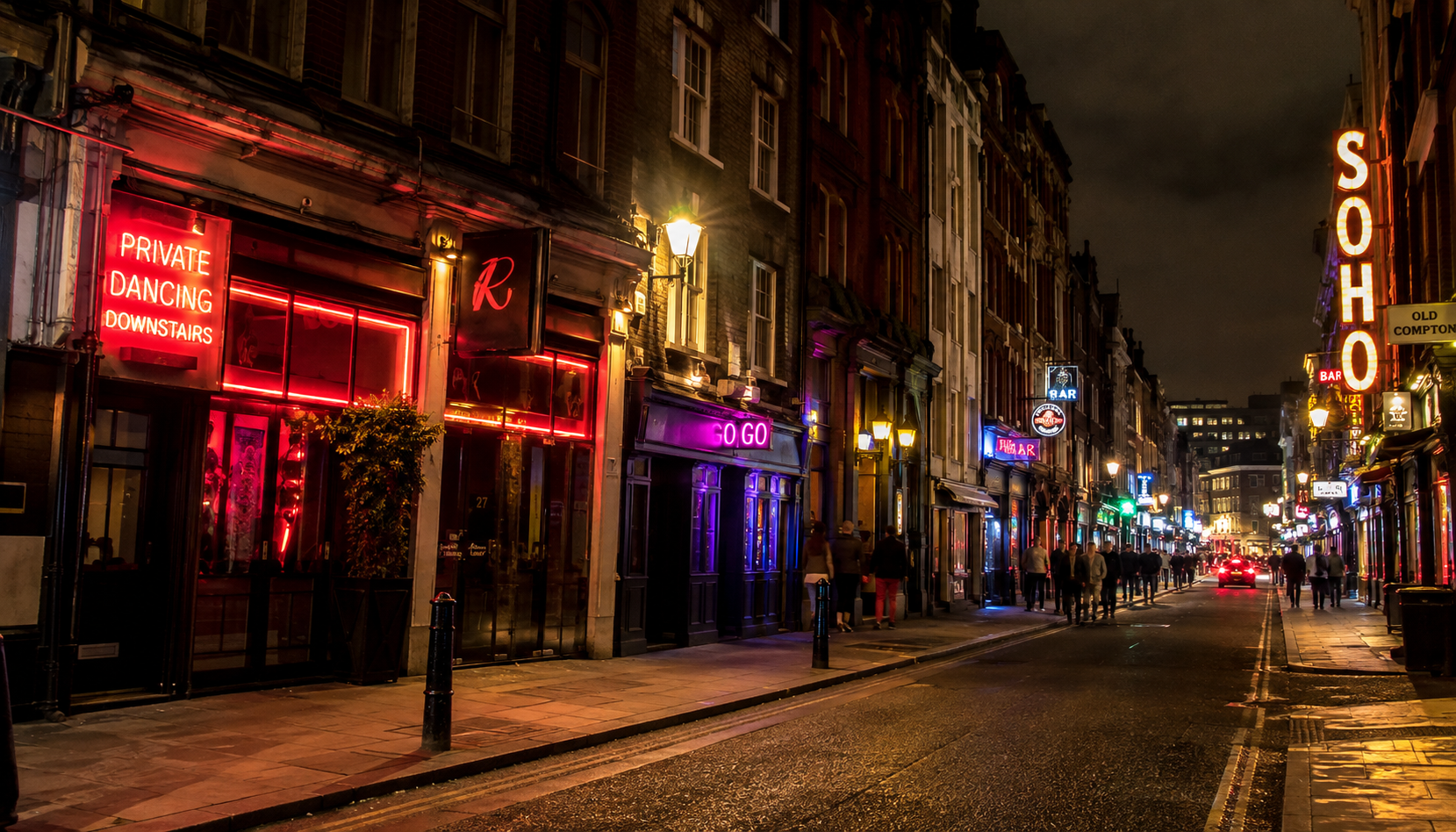
For visitors, Soho could seem exciting, mysterious, and somewhat intimidating. Bright signs and neon displays became part of its visual identity. Neon itself became closely associated with the district, with signs advertising adult businesses contributing to the distinctive nighttime atmosphere. Researchers examining Soho’s changing lightscape have noted how neon became an important marker of the neighborhood’s identity.
However, this period also had a darker side. Organized crime, exploitation, corruption, and fraudulent businesses became concerns. Some establishments were notorious for taking advantage of visitors through misleading advertising and inflated charges.
During the 1980s, authorities and Westminster officials increasingly tightened licensing and enforcement. Community groups also pushed for improvements to the neighborhood. As licensing controls increased and illegal businesses were targeted, the number of sex-industry premises declined significantly.
The transformation wasn’t immediate, but it marked the beginning of the end of Soho’s traditional red-light identity. By the 1990s and early 2000s, redevelopment, changing laws, policing, rising property values, and the growth of the internet were reshaping the industry.
So, when people imagine red light street London through old photographs or films, they’re often picturing this particular period rather than the Soho visitors encounter today.
What Happened to the Traditional Red-Light District?
Soho hasn’t simply been “cleaned up”; it has undergone a broad social and economic transformation. Several forces contributed to the decline of its traditional sex industry.
One major factor was stricter licensing and enforcement. Westminster authorities gradually reduced the concentration of adult businesses, particularly establishments that operated illegally or generated complaints. The decline of traditional street-based activity was also influenced by changes in policing and legislation.
Technology played another important role. As the internet became widespread, adult entertainment and commercial sexual services increasingly moved online. Consumers no longer needed to visit a particular neighborhood to find information or entertainment. This reduced the importance of physically concentrated districts.
Gentrification also changed Soho. Property values increased, businesses changed, and new restaurants, offices, hotels, retailers, and entertainment venues moved into the area. Academic research on Soho describes this broader process as part of the regeneration and redevelopment of traditional red-light districts.
The visual character of the neighborhood changed as well. Some of the famous adult venues disappeared, while former sex-industry locations were redeveloped or given new uses. Even so, elements of the old identity remain embedded in the streetscape and local history.
This makes modern Soho an interesting example of urban change. The neighborhood demonstrates how a district can retain its cultural memory while developing a completely different economic and social identity.
Rather than thinking of Soho as a single “red-light street,” it’s more accurate to understand it as a historic entertainment district whose adult-industry presence was once much more prominent than it is today.
Soho Beyond the Red-Light Label
Reducing Soho to its red-light history misses much of what makes the area important. Long before and alongside its association with adult entertainment, Soho developed a reputation for food, music, theater, art, nightlife, and cultural diversity.
The neighborhood became particularly important to London’s LGBTQ+ history. During periods when homosexuality was heavily restricted and stigmatized, Soho provided spaces where LGBTQ+ people could socialize. Historic venues such as the Colony Room became part of the area’s artistic and queer history. Historic England documents the importance of the Colony Room and other Soho venues in the development of the neighborhood’s social culture.
Music has also been central to Soho’s identity. Clubs, pubs, cafés, and live venues attracted musicians, performers, writers, and artists. The area’s compact streets encouraged a lively mixture of people and businesses.
Food remains another major attraction. Soho has long been known for international restaurants and cafés, reflecting the immigrant communities that helped shape the district. Westminster’s own public-realm research highlights Soho’s long-standing international food culture and its importance to street life.
Today, visitors are more likely to encounter restaurants, theaters, cocktail bars, independent stores, cafés, and cultural attractions than the adult businesses that once dominated the neighborhood’s reputation.
That doesn’t mean the history has vanished. Instead, it has become one layer of a much broader story. A walk through Soho can reveal traces of its nightlife past while simultaneously showing how London continually reinvents its neighborhoods.
Visiting Soho Today: What Travelers Should Expect
If you’re visiting London and searching for the famous red light street London experience, it’s important to set realistic expectations. Modern Soho isn’t a single street lined with obvious red lights. The historic adult district has changed considerably, and much of what once made it famous has disappeared.
Instead, visitors will find a busy central London neighborhood with restaurants, pubs, theaters, shops, nightlife venues, and cultural landmarks. Streets around areas such as Brewer Street, Berwick Street, Old Compton Street, Dean Street, and surrounding lanes are part of the wider Soho experience, although their modern character varies considerably.
Old Compton Street is particularly associated with Soho’s LGBTQ+ history and contemporary nightlife. Berwick Street is known for its market and food businesses, while the surrounding streets offer everything from casual dining to high-end restaurants and late-night entertainment.
For first-time visitors, the best approach is to treat Soho as a historic neighborhood rather than searching for a single “red-light street.” Walking through the district during the early evening gives you an opportunity to see its restaurants, theaters, bars, architecture, and busy streets without reducing the area to its former adult-entertainment reputation.
Visitors should also use normal city-safety precautions, particularly at night. Stay aware of your belongings, be cautious about unsolicited offers, and check prices before purchasing anything in nightlife venues.
The biggest surprise for many travelers is how ordinary and lively modern Soho can feel. Its past is distinctive, but its present identity is much broader.
Conclusion
The story of red light street London is really the story of how Soho evolved. Once strongly associated with prostitution, adult cinemas, sex shops, neon signs, and nightlife, the neighborhood has undergone decades of regulation, redevelopment, technological change, and gentrification. Today, Soho is a much broader cultural destination, celebrated for restaurants, theaters, nightlife, LGBTQ+ history, music, and its international character. Its former red-light reputation remains an important part of London’s social history, but it shouldn’t define the neighborhood entirely. For modern visitors, Soho offers something more interesting: the chance to experience a place where layers of history, culture, entertainment, and urban change remain visible within a remarkably compact part of central London.
Frequently Asked Questions
Is there still a red-light district in London?
London no longer has a single, clearly defined red-light district comparable to the popular image of such areas in some European cities. Soho historically had a major concentration of adult businesses, but its sex industry has declined substantially and changed in form.
What area of London was famous for red lights?
Soho is the London neighborhood most strongly associated with the historic red-light district. Parts of the area around Brewer Street, Berwick Street, Walker’s Court, and surrounding streets were particularly associated with adult entertainment during the 20th century.
Is Soho still known for adult entertainment?
Some adult-oriented businesses remain in and around Soho, but they represent only one small part of the neighborhood. Modern Soho is much better known for restaurants, nightlife, theaters, shopping, LGBTQ+ culture, and entertainment.
Why did Soho become a red-light district?
Its central West End location, entertainment economy, nightlife, relatively inexpensive premises during certain periods, and long history of bohemian and alternative culture all contributed to its development as a center for the sex industry.
Can tourists safely visit Soho?
Yes. Soho is a major central London neighborhood visited by large numbers of tourists and residents. As with any busy nightlife district, visitors should remain aware of their surroundings, protect valuables, and use reputable businesses.
