
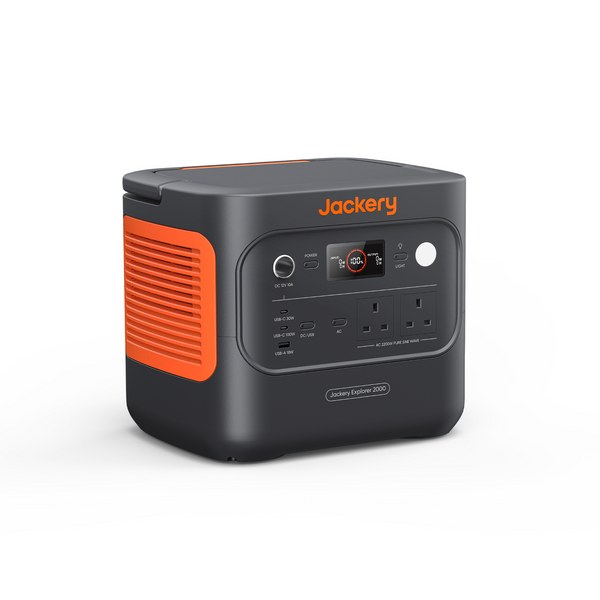
Buying a portable power station is a bit like buying a car: get one that is too small and you will run out of power when you need it most, but buy too big and you pay for capacity and weight you never use. Jackery’s Explorer range now covers everything from a 99Wh pocket unit to a 3kWh home backup station.
In this guide we explain the two numbers that matter, give you a simple way to estimate runtime, and compare seven current Explorer models with UK prices from Jackery’s official UK store at the time of writing.
In this guide
- Watt-Hours vs Watts: The Two Numbers That Matter
- A Simple Runtime Rule of Thumb
- Seven Explorer Models Compared
- Small: Explorer 100 Plus
- Medium: Explorer 500 v2 and 1000 v2
- Expandable: Explorer 1000 Plus v2 and 2000 Plus v2
- Large: Explorer 2000 v2 and 3000 v2
- Battery Life: How Long Will It Last?
- How to Choose: Quick Checklist
- Conclusion
- Frequently Asked Questions
Watt-Hours vs Watts: The Two Numbers That Matter
- Capacity, in watt-hours (Wh), tells you how much energy is stored. Think of it as the size of the fuel tank.
- Output, in watts (W), tells you how much power the station can deliver at once. It decides which appliances you can plug in.
- Check both: a kettle needs high output, while running a fridge overnight needs a big capacity.
A Simple Runtime Rule of Thumb
To estimate runtime, divide the capacity by the power your device uses, then allow for some energy lost in conversion. As a rough guide, multiply the capacity by about 0.85 first. For example, a 1,070Wh station running a 60W device gives around 1,070 x 0.85 / 60, or roughly 15 hours. Real results depend on the device and conditions, so treat this as an estimate.
Seven Explorer Models Compared
| Model | Capacity | Output | Best for | UK price |
|---|---|---|---|---|
| Explorer 100 Plus | 99Wh | 128W | Phones, laptops, flights | £79 |
| Explorer 500 v2 | 512Wh | 500W | Weekends, small fridge | £329 |
| Explorer 1000 v2 | 1,070Wh | 1,500W | All-rounder | £419 |
| Explorer 1000 Plus v2 | 1,024Wh, up to 11kWh | 1,800W | Start small, expand later | £599 |
| Explorer 2000 v2 | 2,042Wh | 2,200W | Bigger appliances | £807 |
| Explorer 2000 Plus v2 | 2,048Wh, up to 12kWh | 2,400W (4,800W peak) | Home backup that grows | £949 |
| Explorer 3000 v2 | 3,072Wh | 3,600W (7,200W peak) | Maximum power | from £1,424 |
Check today’s Jackery UK prices.
Small: Explorer 100 Plus
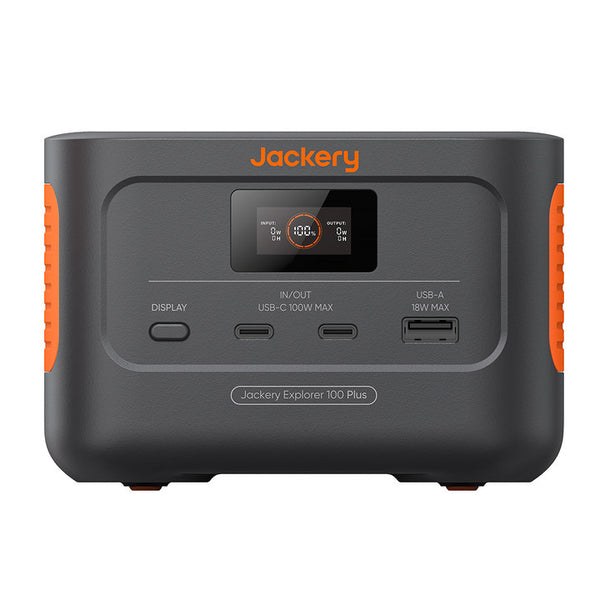
The Explorer 100 Plus is really a super-sized power bank. It holds 99Wh, delivers 128W, uses a long-life LFP battery rated for 2,000 cycles to 80% capacity, and weighs just 2.13 lbs. Jackery says it is airline approved, which makes it ideal for travel. At £79 it is the cheapest way into the range.
Medium: Explorer 500 v2 and 1000 v2
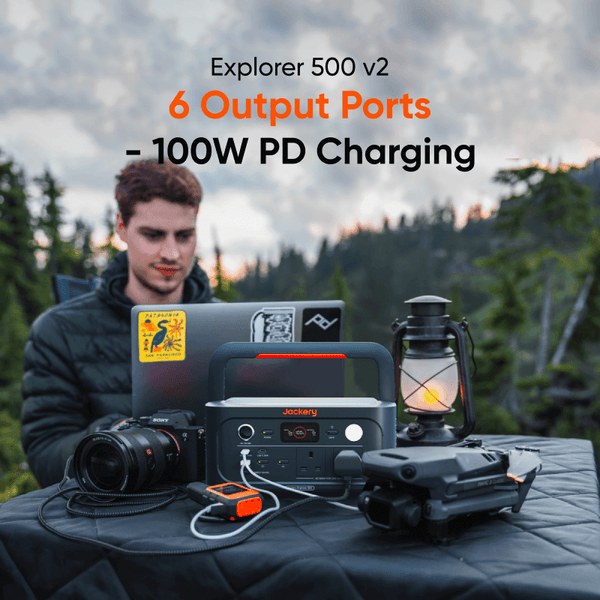
The Explorer 500 v2 stores 512Wh with 500W output, enough for phones, laptops, lights and a small fridge. Jackery calls it the lightest and smallest 0.5kWh station, at 5.7kg, and rates its LiFePO4 battery for 6,000 cycles. Combine AC and solar and it can fully charge in about an hour. It costs £329.
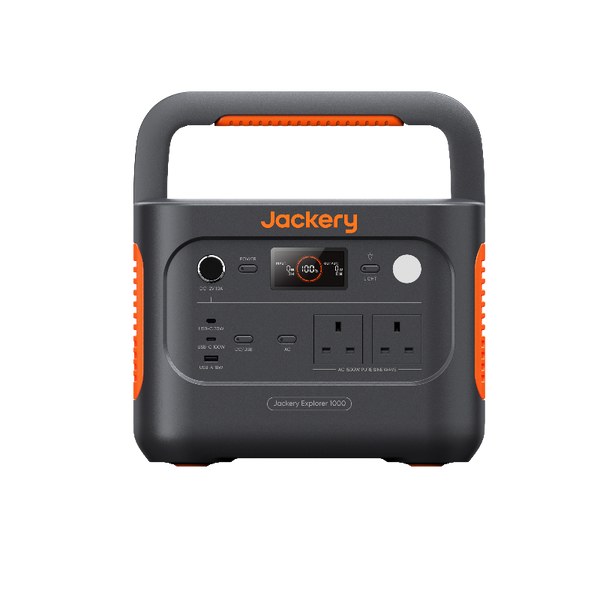
For most people the Explorer 1000 v2 is the sweet spot. It offers 1,070Wh and 1,500W output, a LiFePO4 battery rated for 4,000 cycles, emergency super charging in as little as an hour, and quiet running under 22dB. At £419 it currently offers the most capacity per pound in the range. See the Explorer 1000 v2.
Expandable: Explorer 1000 Plus v2 and 2000 Plus v2
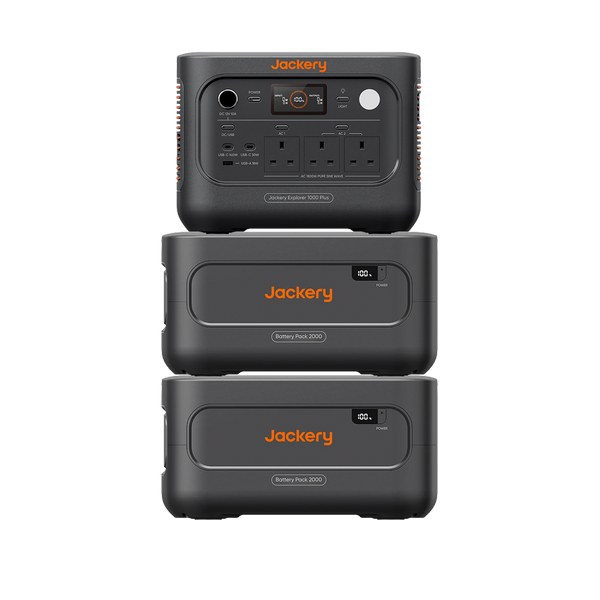
The Plus models let you start with one unit and add Battery Pack 2000 expansion batteries later. The Explorer 1000 Plus v2 starts at 1,024Wh with 1,800W output and expands up to 11kWh, from £599. Bundles with one battery pack (3kWh) cost £1,248.
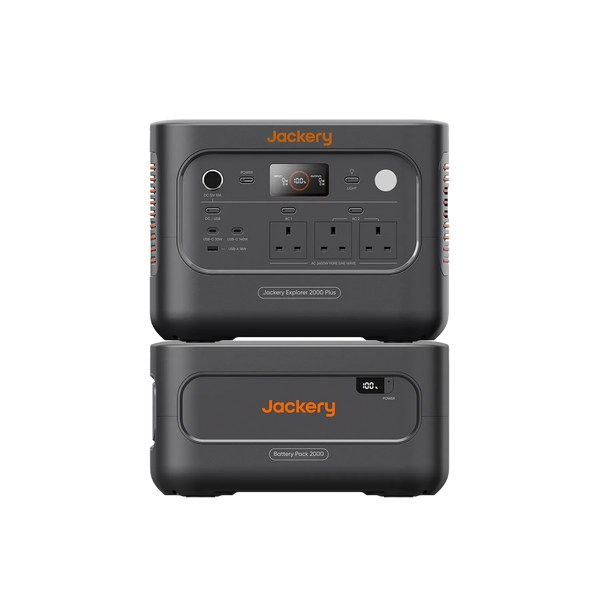
The Explorer 2000 Plus v2 starts at 2,048Wh and 2,400W, with 4,800W peak, and can grow to 12kWh. Jackery says it can run refrigerators, microwaves and coffee makers. It costs £949, or £1,598 with one battery pack (4kWh). Both Plus models let you control AC outlets separately from the Jackery app.
Large: Explorer 2000 v2 and 3000 v2

If you need a lot of power but do not plan to expand, the Explorer 2000 v2 offers 2,042Wh and 2,200W in a unit weighing 38.6 lbs, which Jackery says is 35.6% lighter than the industry standard. It can be fully charged in 1.33 hours with emergency super charge, and costs £807.
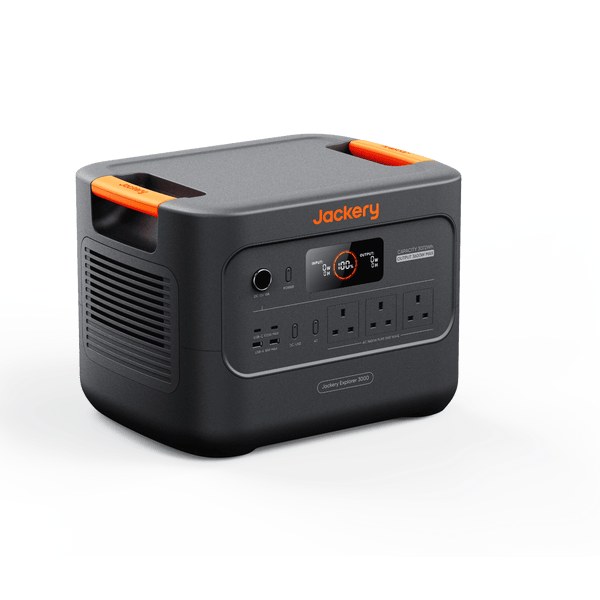
The Explorer 3000 v2 is the flagship, with 3,072Wh, 3,600W output, 7,200W peak power and eight output ports. Jackery says it can run a fridge for more than 30 hours. Prices start at £1,424.
Battery Life: How Long Will It Last?
Every model in this guide uses lithium iron phosphate (LFP or LiFePO4) cells, which last far longer than older lithium-ion batteries. Jackery quotes different cycle ratings for each model:
- Explorer 100 Plus: 2,000 cycles to 80% capacity.
- Explorer 1000 v2 and 2000 v2: 4,000 cycles, which Jackery says means about 10 years of daily use.
- Explorer 500 v2: 6,000 cycles, the highest rating in the range.
If you plan to use your station every day, for example with solar panels to cut your energy bills, a high cycle rating matters as much as capacity.
How to Choose: Quick Checklist
- Only charging phones and laptops: Explorer 100 Plus.
- Weekend camping with lights and a cool box: Explorer 500 v2.
- Longer trips or basic power-cut cover: Explorer 1000 v2.
- Not sure how much you will need in future: a Plus model.
- Running bigger kitchen appliances: Explorer 2000 v2, 2000 Plus v2 or 3000 v2.
Conclusion
Start by listing what you want to power and for how long, then use the runtime rule above. For most buyers the Explorer 1000 v2 at £419 is the best all-rounder, while the Plus models are the smart choice if your needs may grow. Find the right Jackery Explorer for you.
Frequently Asked Questions
What is the difference between Wh and W?
Wh is how much energy the battery stores; W is how much power it can deliver at once.
Which Jackery can I take on a plane?
Jackery describes the Explorer 100 Plus as airline approved. Always check with your airline.
Can I add batteries later?
Yes, with the Explorer 1000 Plus v2 and 2000 Plus v2, using Battery Pack 2000 units.
