



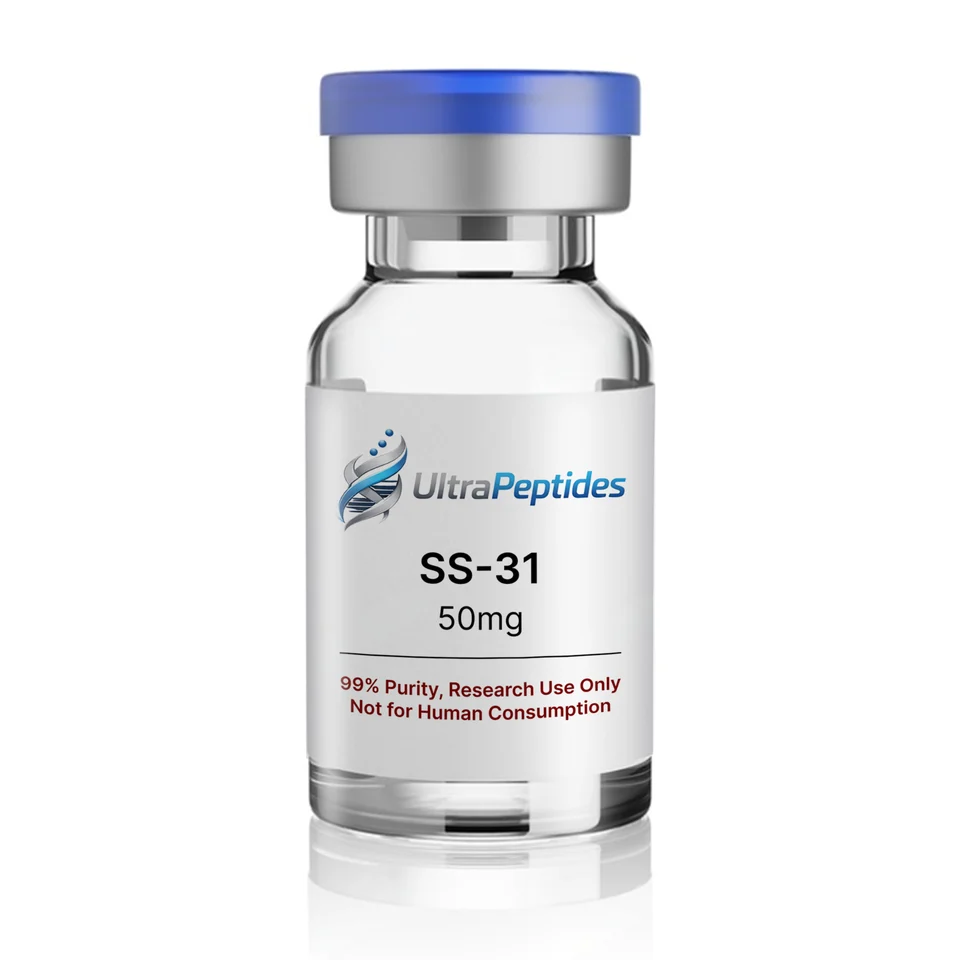
Most compounds studied for mitochondrial disease never make it past cell cultures and animal models. SS-31 has. It’s now the first mitochondria-targeted ss-31 peptide to reach FDA approval, and that milestone has made it one of the most closely followed subjects in mitochondrial peptide research today.
What SS-31 Actually Is
SS-31, commonly referred to as elamipretide, is a tiny peptide that is made up of four amino acids. Its most remarkable distinction lies not in the type of receptor it triggers but in its selective properties. Upon application to cells, SS-31 can target the inner membrane of mitochondria and reach its concentrated position within cells quite rapidly.
Why Cardiolipin Matters
Cardiolipin has been identified as a pivotal player in mitochondrial metabolic processes that provide energy from food and nutrients. In cases of cardiolipin impairment, a series of events will occur in the mitochondria, involving excessive folding of the mitochondrial membranes and decreased energy production, as well as increased oxidative stress. In recent studies, scientists have demonstrated that the process of cardiolipin malfunction takes place in various diseases like heart dysfunction, kidney diseases, neurodegenerative disorders, and the aging process.
Stabilization of cardiolipin with the help of SS-31 is suggested to be able to eliminate the problems connected with the malfunctions of cardiolipin, creating desired effects at the same time. This explains the increasing interest of the researchers.
The Approval That Changed Its Status
In September 2025, the FDA approved elamipretide under the trade name FORZINITY to treat Barth syndrome. This is a rare mitochondrial disease caused by mutations in the TAFAZZIN gene. Its approval was based on an open-label extension trial that showed patients treated with FORZINITY achieved notable gains in mobility and cardiac stroke volume.
This approval matters for the wider field of mitochondrial peptide research because it’s a proof of concept.
Where the Evidence Gets More Complicated
This endorsement is noteworthy for its limitations. The Bachmann condition is rare, and SS31 research results in other diseases have been inconsistent. In some successful larger trials of heart failure studies and mitochondrial myopathy, the peptide was unsuccessful in fulfilling the main objectives, but some positive results were achieved in minor goals.
Research into age-related macular degeneration is already in existence. Phase 3 trials are expected in 2025 for age-related macular degeneration. Research into the impact of SS-31 on people with cardiomyopathy associated with Duchenne muscular dystrophy is also being performed, in which the scarring of the heart muscle is used as a research method.
Why It’s Still Worth Watching
The relevance of SS-31 in peptide research does not come from its successful history. Instead, it relies on the presence of the well-studied and structurally selective mechanism together with recent human trial results, something that is not common among peptides. Nevertheless, even in the cases when the results are not entirely positive, there is still a basis for further studies.
Moreover, there is a good safety record throughout the studies, with the only side effects being mild local reactions and headaches. It is the combination of all these features that makes SS-31 so appealing within scientific society, even though some of the trials have not been successful.
Final Thoughts
SS-31 enjoys a distinctive position in mitochondrial research: partly validated, still being tested, and ever-attentively scrutinized. Its validity in the treatment of Barth syndrome demonstrates that the basic mechanism of action is effective in patients. However, whether the same mechanism will be effective in the treatment of other diseases such as heart failure, eye disease, or myopathy remains to be seen, and it is likely to influence future research in peptides related to mitochondria.


