



Introduction
Fire has fascinated people for thousands of years. It can warm a home, light a dark path, destroy what stands in its way, and even inspire a sense of wonder. Because of this powerful dual nature, fire has become one of the most recognizable symbols across cultures and belief systems. The fire symbol meaning can vary depending on the situation, but it often connects with transformation, passion, energy, purification, and renewal. In spiritual traditions, fire may represent divine presence or inner awakening. In everyday life, it can symbolize determination, creativity, love, or a fresh start. Understanding these different meanings can help you see why fire appears so often in art, rituals, dreams, stories, and personal symbolism.
What Does the Fire Symbol Represent?
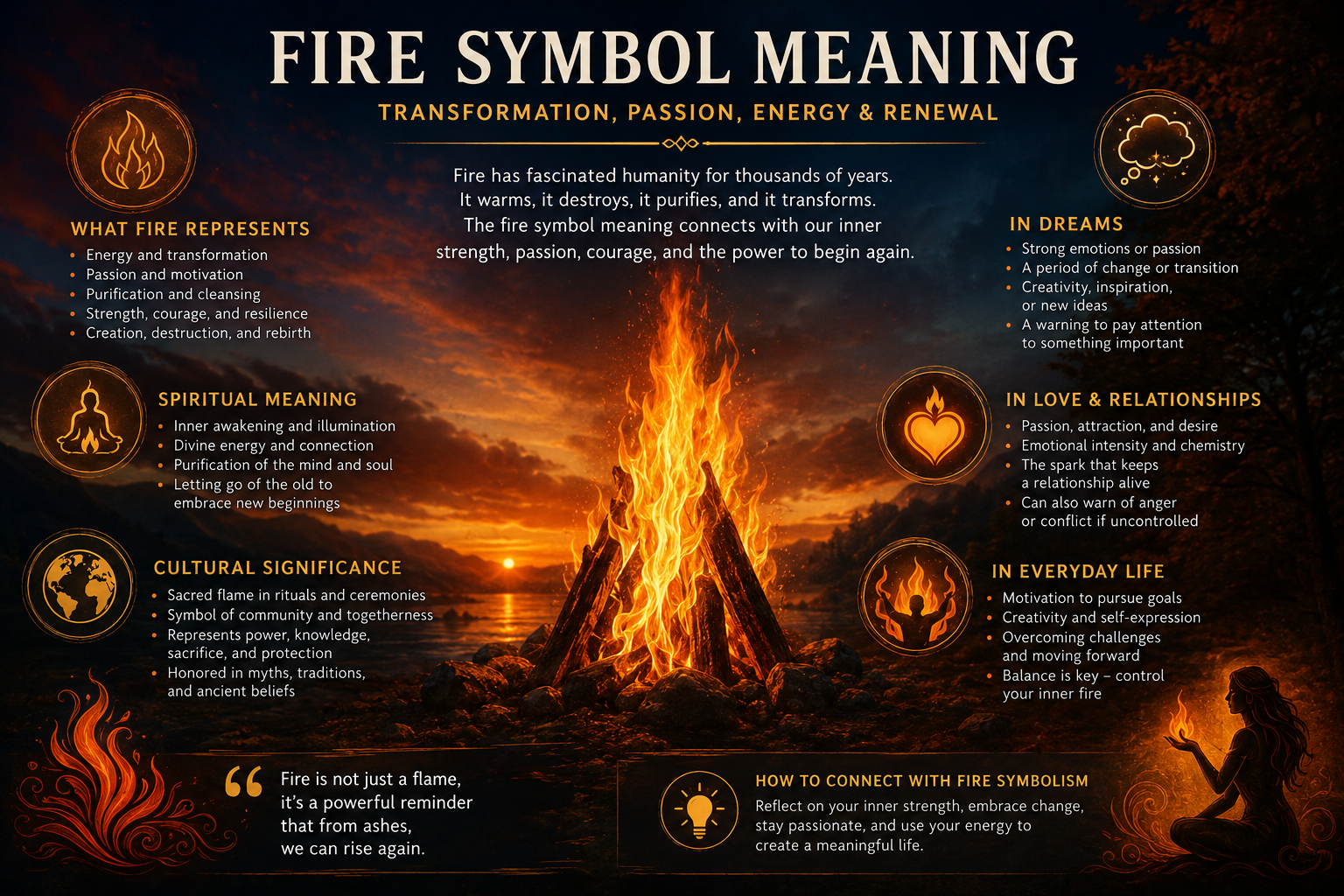
At its core, fire represents energy and transformation. Unlike many natural elements, fire changes whatever it touches. Wood becomes ash, darkness becomes light, and cold spaces become warm. This ability to transform makes fire a natural symbol for personal growth and major life changes.
Fire is also strongly associated with passion. When someone is described as having a “fire within,” it usually means they’re motivated, ambitious, courageous, or emotionally intense. In this sense, the fire symbol can represent the drive that pushes a person toward a goal even when the path becomes difficult.
Another common interpretation is purification. Fire has long been used in rituals involving cleansing, renewal, and the removal of unwanted things. Symbolically, burning something away can represent letting go of an old habit, relationship, fear, or chapter of life.
There’s also an important contrast in fire symbolism: it can create and destroy. A controlled flame can provide warmth and light, while an uncontrolled fire can cause tremendous damage. This duality makes fire a powerful reminder that energy itself isn’t necessarily good or bad. What matters is how that energy is directed.
For many people, the fire symbol therefore represents strength, change, courage, passion, creativity, and rebirth. Its meaning becomes more specific when you consider the cultural, spiritual, or personal context in which it appears.
Spiritual Meaning of Fire and Its Connection to Transformation
In spiritual symbolism, fire is often connected with awakening and transformation. A flame can represent an inner light—the part of a person that remains alive even during challenging periods. This is why candles and sacred fires appear in many religious and spiritual practices around the world.
The spiritual meaning of fire can also involve purification. Metaphorically, people sometimes describe difficult experiences as a “trial by fire.” The idea is that challenges can remove what no longer serves us and reveal greater strength underneath. Fire doesn’t simply destroy in this interpretation; it prepares something for a new beginning.
Fire is also linked with divine energy and revelation. A flame illuminates what would otherwise remain hidden, making it a natural symbol of knowledge, truth, and spiritual insight. In meditation and spiritual practices, focusing on a flame can represent concentration, awareness, and the search for inner clarity.
Another important theme is rebirth. Fire consumes, but the end of one thing can create the conditions for something new. This is why fire symbolism often appears alongside ideas such as renewal, resilience, and personal evolution.
If you’re drawn to fire imagery during a period of change, you might interpret it as a reminder to embrace transformation rather than resist it. The symbol doesn’t necessarily suggest that change will be easy. Instead, it can represent the courage to move through uncertainty and emerge with a clearer sense of who you are.
Fire Symbolism in Different Cultures and Traditions
Fire has held a significant place in cultures across the world, although its specific meaning differs from one tradition to another. In many ancient societies, fire was considered sacred because it provided warmth, light, cooking, protection, and survival. These practical benefits naturally became connected with spiritual ideas.
In ancient religious traditions, sacred flames could represent communication between humans and the divine. Fire was used in ceremonies, offerings, festivals, and purification rituals. The flame could be viewed as a bridge between the physical and spiritual worlds.
Fire also appears prominently in mythology. Stories frequently use flames to represent power, knowledge, sacrifice, destruction, or rebirth. The symbolism of fire often becomes especially powerful when a character must pass through a difficult experience before reaching a new stage of life.
In some cultural traditions, fire represents community as well as spirituality. Gathering around a fire creates a shared space, encouraging storytelling, celebration, and connection. A flame can therefore symbolize not only individual energy but also the warmth of human relationships.
The cultural meaning of fire has also evolved in modern times. Today, flames may appear in logos, tattoos, jewelry, artwork, fashion, and personal rituals. Someone might choose a fire symbol to represent ambition, independence, overcoming adversity, or starting over.
Because fire appears in so many traditions, there isn’t one universal interpretation. Context matters. The same flame may symbolize sacredness in one setting, passion in another, and destruction somewhere else. That flexibility is part of what makes fire such an enduring and meaningful symbol.
Fire Symbol Meaning in Dreams, Love, and Everyday Life
The meaning of fire can become especially personal when it appears in dreams or relationships. In dreams, fire may symbolize strong emotions, change, pressure, creativity, or something demanding your attention. A calm flame might suggest warmth, comfort, or focused energy, while a raging fire could reflect feelings that seem difficult to control.
However, dream symbolism isn’t an exact science. The most useful interpretation usually depends on what the fire was doing and how you felt during the dream. Feeling safe beside a fire has a very different emotional meaning from feeling trapped by one.
In love and relationships, fire is commonly associated with passion, attraction, desire, and emotional intensity. Romantic expressions such as “spark,” “flame,” and “burning love” all reflect this symbolism. A small flame can represent a new attraction, while a strong fire may symbolize a deep and powerful connection.
Fire can also represent creativity and motivation in everyday life. Artists, entrepreneurs, athletes, and anyone pursuing a difficult goal may use fire imagery to describe determination. The phrase “keep the fire burning” captures the idea of maintaining enthusiasm even when motivation naturally rises and falls.
At the same time, fire can serve as a warning. Too much emotional intensity can lead to anger, conflict, obsession, or burnout. Symbolically, a healthy fire needs fuel and control. Without balance, something inspiring can become destructive.
That’s why the fire symbol often carries two messages at once: embrace your energy, but learn how to direct it.
How to Interpret the Fire Symbol for Yourself
There’s no single correct interpretation of a fire symbol. Personal context plays a major role. If you’re trying to understand what fire means to you, start by considering where the symbol appeared and what emotions it created.
Ask yourself: Was the fire calm or aggressive? Was it giving warmth or causing destruction? Were you watching it, controlling it, escaping from it, or walking toward it? Your emotional reaction can provide important clues.
For example, a person going through a major career change might see fire as a symbol of reinvention and courage. Someone recovering from a difficult relationship might associate it with letting go of the past. An artist might see a flame as creativity and inspiration, while someone feeling overwhelmed might interpret a wildfire as emotional exhaustion.
You can also think about the qualities of fire that you most admire. Perhaps you connect with its warmth, brightness, persistence, movement, or ability to transform. These qualities may reflect something you’re developing within yourself.
Fire symbolism can be especially meaningful in tattoos, artwork, jewelry, or personal decorations. Rather than choosing a symbol simply because it looks attractive, consider the story you want it to tell. A flame can represent surviving hardship, protecting your inner strength, pursuing a dream, or beginning again.
Ultimately, the most meaningful fire symbol is one that reflects your own experience. Traditional symbolism can provide a starting point, but your memories, emotions, and circumstances give the symbol its personal meaning.
FAQs About Fire Symbol Meaning
What is the main meaning of the fire symbol?
The fire symbol commonly represents transformation, passion, energy, purification, courage, and renewal. Its exact meaning depends on the context.
What does fire symbolize spiritually?
Spiritually, fire can symbolize inner awakening, divine energy, purification, illumination, and transformation. It’s often associated with moving through challenges and beginning a new chapter.
Is fire a symbol of love?
Yes. Fire frequently symbolizes romantic passion, attraction, desire, and emotional intensity. A flame or spark can represent the beginning or strength of a romantic connection.
What does fire mean in a dream?
Fire in a dream can represent strong emotions, transformation, creativity, conflict, or a situation that feels intense. Your feelings during the dream are important when interpreting it.
Is fire a positive or negative symbol?
Fire can represent both positive and negative forces. It may symbolize warmth, creativity, courage, and renewal, but it can also represent anger, destruction, danger, or uncontrolled emotions.
What does a fire tattoo symbolize?
A fire tattoo can represent passion, strength, resilience, transformation, independence, or overcoming hardship. The meaning depends on the individual and the design.
Conclusion
The fire symbol meaning is powerful because fire itself contains so many contradictions. It can comfort and threaten, illuminate and consume, destroy and create. Across spiritual traditions, cultures, dreams, relationships, and personal expression, fire often represents transformation, passion, courage, purification, and renewal. Its message can be especially meaningful during periods of change, when you’re leaving something behind and moving toward something new. Ultimately, there’s no single interpretation that applies to everyone. The most meaningful symbolism comes from the context and emotions surrounding the flame. Whether you see fire as an inner spark, a source of strength, or a reminder to embrace change, its symbolism continues to inspire people in remarkably different ways.


