





Introduction
Choosing a new boiler isn’t a decision you’ll want to make lightly. Your boiler affects your heating bills, hot water supply and, in some cases, your home’s carbon footprint. With energy prices and efficiency becoming increasingly important, many homeowners are now comparing a gas or electric combi boiler before replacing an old heating system.
Both options can provide reliable heating and hot water, but they work in very different ways. Gas combi boilers have been a popular choice in UK homes for decades, while electric boilers are becoming more appealing where gas isn’t available or homeowners want to move away from fossil fuels.
So, which one is right for you? Let’s compare the key differences, including running costs, efficiency, installation, maintenance and environmental impact.
How Do Gas and Electric Combi Boilers Work?
A gas combi boiler burns natural gas to heat water, which is then circulated around your central heating system or delivered directly to your taps when you need hot water. There’s no separate hot water cylinder or storage tank, making combi boilers particularly convenient for smaller homes.
An electric combi boiler works on a different principle. Instead of burning fuel, it uses electricity to heat water through electrical heating elements. Like a gas combi, it can provide heating and hot water without requiring a traditional hot water cylinder, depending on the system and model.
One major difference is the infrastructure each boiler needs. A gas boiler requires a connection to the mains gas supply, a flue for combustion gases and appropriate ventilation. It also needs regular servicing by a qualified heating engineer.
Electric boilers don’t burn fuel, so they don’t produce combustion gases and don’t require a flue or gas connection. This can make installation more straightforward in certain properties, particularly homes that aren’t connected to the gas network.
In terms of everyday use, both can offer convenient heating and hot water. However, performance can vary depending on the boiler’s output, the size of your property and how much hot water your household uses.
Which Has Lower Running Costs?
For many homeowners, running costs are the biggest factor when choosing between a gas or electric combi boiler. Unfortunately, there isn’t a simple answer for every property because energy tariffs and household usage vary.
Generally, natural gas has historically been cheaper per unit of energy than electricity in the UK. This means a modern, efficient gas boiler can often be less expensive to run than a standard electric boiler, particularly in a home with high heating and hot water demand.
Electric boilers do have an important advantage: they convert almost all the electricity they use into heat at the point of use. Gas boilers, even highly efficient models, lose some energy through the combustion process and flue.
However, higher efficiency doesn’t automatically mean lower bills. The price you pay for each unit of electricity matters. If electricity costs considerably more than gas, an electric boiler can still be more expensive to operate despite its excellent efficiency.
Your home also makes a difference. A well-insulated property with low heat demand may work perfectly well with an electric boiler. In contrast, a larger, poorly insulated house could have considerably higher heating requirements.
Before deciding, it’s worth comparing your current energy tariffs, annual consumption and expected heating demand rather than looking at boiler efficiency alone. A heating professional can also calculate the appropriate boiler output for your property.
Installation, Maintenance and Lifespan
Installation is another area where gas and electric boilers differ considerably. A gas combi boiler needs a suitable gas supply, flue system, condensate connection and installation by a Gas Safe registered engineer. If your property already has gas central heating, replacing an existing boiler can be relatively straightforward.
An electric boiler generally has fewer installation requirements. There’s no flue, gas pipework or combustion system, which can provide more flexibility over where the boiler is installed. However, the electrical supply needs to be capable of handling the boiler’s power demand. In some properties, upgrading the electrical infrastructure may be necessary.
Maintenance is another consideration. Gas boilers contain burners and other combustion components that need inspection and servicing. An annual boiler service is commonly recommended to keep the system operating safely and efficiently.
Electric boilers have fewer moving and combustion-related components, so they can be simpler to maintain. There’s no risk associated with gas combustion and no flue to inspect for combustion gases. That doesn’t mean maintenance can be ignored, though. Electrical connections, heating elements, pumps and controls can still require attention.
Lifespan depends on the individual boiler, installation quality, usage and maintenance. Rather than choosing solely on expected lifespan, consider the total cost of ownership, including installation, servicing, repairs and energy bills.
Which Boiler Is More Environmentally Friendly?
Environmental impact is becoming an increasingly important consideration for homeowners. On this point, electric boilers have an obvious advantage: they don’t burn fossil fuels inside the home and produce no direct combustion emissions.
That doesn’t necessarily mean every electric boiler is automatically greener than every gas boiler. The overall environmental impact of electric heating depends partly on how the electricity is generated. As the UK electricity grid uses more renewable energy, electric heating can become increasingly attractive from a carbon perspective.
A gas boiler, by comparison, burns natural gas and produces carbon dioxide during operation. Although modern condensing gas boilers are much more efficient than older models, they still rely on a fossil fuel.
Electric boilers can also work well alongside renewable electricity generation, such as solar panels. If your home produces some of its own electricity, you may be able to reduce the amount of grid electricity required for heating, although this depends on your household’s energy use and the system you install.
There’s also a wider question about future-proofing your heating system. Government policies and the wider energy market are increasingly focused on reducing emissions from buildings. For some homeowners, an electric heating system may therefore seem like a more future-facing choice.
That said, heat pumps are another option worth considering if reducing carbon emissions is a priority. They operate differently from electric resistance boilers and can provide much greater energy efficiency under suitable conditions.
Gas or Electric Combi Boiler: Which Should You Choose?
The best choice ultimately depends on your property, budget and heating requirements. There isn’t one boiler type that will suit every household.
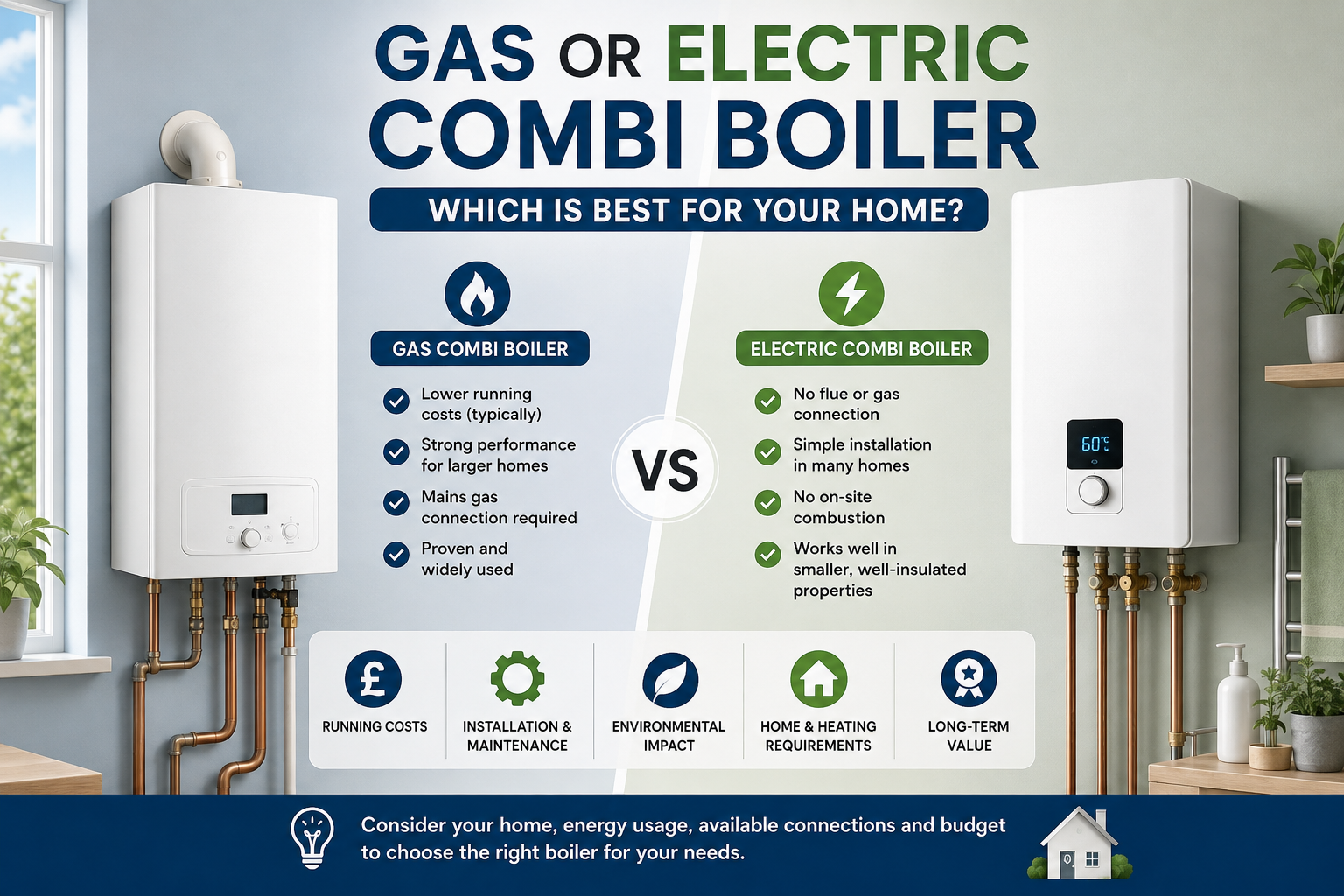
A gas combi boiler may make sense if your property already has a mains gas connection, you have relatively high heating demand and keeping running costs down is a priority. Modern gas combi boilers can deliver strong heating performance and a dependable supply of hot water without needing a cylinder.
An electric combi boiler could be attractive if your home isn’t connected to the gas network, you want a simpler installation or you’re keen to avoid combustion appliances. They can also be particularly suitable for smaller, well-insulated properties with modest heating requirements.
However, there’s an important point to remember: an electric boiler may require a substantial electrical supply. For a larger home, the power requirement can make an electric boiler less practical or more expensive to operate.
Before choosing, consider your property size, insulation, number of bathrooms, hot water demand, current energy tariffs and available utilities. Don’t simply choose the boiler with the highest efficiency percentage.
If you’re replacing an existing system, ask a qualified heating professional to assess your home. They can help determine the required boiler output and explain whether your existing radiators, pipework and electrical or gas supply are suitable.
FAQs About Gas and Electric Combi Boilers
Is an electric combi boiler cheaper than gas?
Not usually when comparing standard household running costs. Electricity generally costs more per unit than mains gas, although this varies with tariffs. An electric boiler can still be economical in a small, well-insulated property with low heating demand.
Are electric combi boilers worth it?
They can be. Electric boilers are worth considering if your property doesn’t have mains gas or you want to avoid combustion appliances. They’re especially useful where a straightforward installation is possible and heating demand is relatively low.
Can an electric boiler heat a whole house?
Yes, provided it has enough output for the property. However, larger homes can require substantial electrical power, so the electrical supply and expected running costs should be assessed before installation.
Which is more efficient, gas or electric?
At the point of use, electric boilers can convert almost all their electricity into heat. Modern gas boilers are also highly efficient, but their overall efficiency is lower. However, efficiency alone doesn’t determine running costs because electricity and gas have different prices.
Can I replace a gas combi boiler with an electric one?
In many cases, yes, but the suitability of the electrical supply needs to be checked. Your heating system, boiler output and household demand should also be assessed before making the switch.
Conclusion
When comparing a gas or electric combi boiler, there’s no universal winner. Gas can offer lower running costs and strong performance for homes with mains gas, while electric boilers provide a cleaner-at-the-point-of-use alternative with simpler installation requirements.
The right choice depends on your property, energy usage, available connections and long-term priorities. If you’re mainly concerned about affordability, a modern gas combi may be the practical option. If you’re looking to move away from gas, an electric boiler could be worth considering.
Before making a final decision, get professional advice based on your home rather than choosing solely on headline efficiency figures. A properly sized and correctly installed boiler will always give you a better starting point.


